Trump Files Explosive $10 Billion Lawsuit Against IRS and Treasury Over Leaked Tax Records
Donald Trump
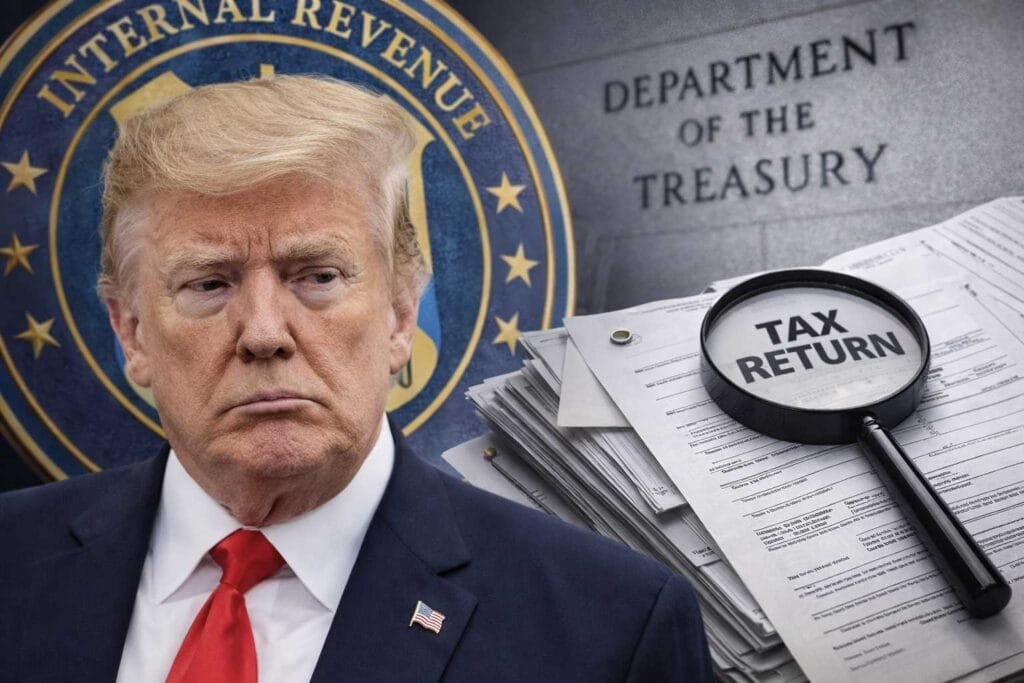
President Donald Trump has filed a sweeping $10 billion (£7.5 billion) lawsuit against the Internal Revenue Service, alleging that a contractor illegally leaked confidential tax return information to journalists, causing what his legal team describes as severe and lasting damage to his reputation.
According to court filings reviewed by NBC News, Trump’s attorneys characterize the disclosures as a politically motivated attack on the Trump family. The complaint was filed Thursday in a federal court in Miami and names both the IRS and the U.S. Treasury Department as defendants.
Notably, the lawsuit was filed in Trump’s personal capacity, not as president of the United States. His sons, Donald Trump Jr. and Eric Trump, are also listed as plaintiffs, along with the Trump Organization.
A spokesperson for Trump’s legal team accused a “rogue, politically motivated” IRS employee of leaking private financial data to “leftist media outlets,” specifically naming The New York Times and ProPublica, according to reporting by Fox News.
At the center of the case is Charles Littlejohn, a former IRS contractor who previously worked for Booz Allen Hamilton. Littlejohn pleaded guilty in October 2023 to one felony count of unauthorized disclosure of tax return information. A federal judge sentenced him to five years in prison in January 2024, according to The Hill.
Prosecutors described the leaks as “unprecedented in scope and scale,” while the sentencing judge went further, calling Littlejohn’s actions “an attack on our constitutional democracy.” CBS News later reported that Littlejohn admitted to stealing Trump’s tax records and deliberately passing them to The New York Times.
The New York Times published a series of stories in 2020 revealing that Trump paid just $750 in federal income taxes in both 2016 and 2017. Littlejohn also leaked confidential tax information on thousands of wealthy Americans to ProPublica, including records belonging to Jeff Bezos and Elon Musk.
Trump’s lawsuit claims the disclosures caused “irreparable harm” to his personal and business reputation. Court documents allege that Littlejohn intentionally sought employment with the IRS to gain access to Trump’s financial records, believing Trump was dangerous and that the public had a right to see his tax returns.
“Defendants have caused Plaintiffs reputational and financial harm, public embarrassment, unfairly tarnished their business reputations, portrayed them in a false light and negatively affected President Trump and the other Plaintiffs’ public standing,” the complaint states. Trump’s attorneys argue that the IRS and Treasury Department either knowingly allowed the breach or acted with gross negligence, and they are seeking punitive damages in addition to the $10 billion claim.
The lawsuit places Trump in an unusual position. As CNBC noted, this is the first known instance of a sitting president suing agencies within his own executive branch. Treasury Secretary Scott Bessent, who is also serving as acting IRS commissioner, was not named as a defendant.
Just days before the lawsuit was filed, the Treasury Department terminated all of its contracts with Booz Allen Hamilton. Bessent said the firm had “failed to implement adequate safeguards to protect sensitive data.”
Trump’s lawyers say they only learned of the breach after receiving a formal notification letter from the IRS dated January 29, 2024. Federal law allows individuals to sue over unauthorized tax disclosures but imposes a strict two-year deadline.
The case is part of a broader legal offensive by Trump since returning to the White House. He is also seeking $10 billion from the BBC over its editing of a January 6, 2021 speech, another $10 billion from The Wall Street Journal over reporting related to Jeffrey Epstein, and $15 billion from The New York Times. JPMorgan Chase is also defending against a separate $5 billion lawsuit.
When asked last year about the optics of suing a government he now leads, Trump acknowledged the unusual nature of the move, calling it “awfully strange” to pursue damages that could ultimately be paid by the federal government. He suggested that any award could be donated to charity or used “to the White House while we restore the White House.”