Blanche Defends DOJ After Epstein Photos Vanish, Says Images Were Pulled to Protect Victims – Not Trump
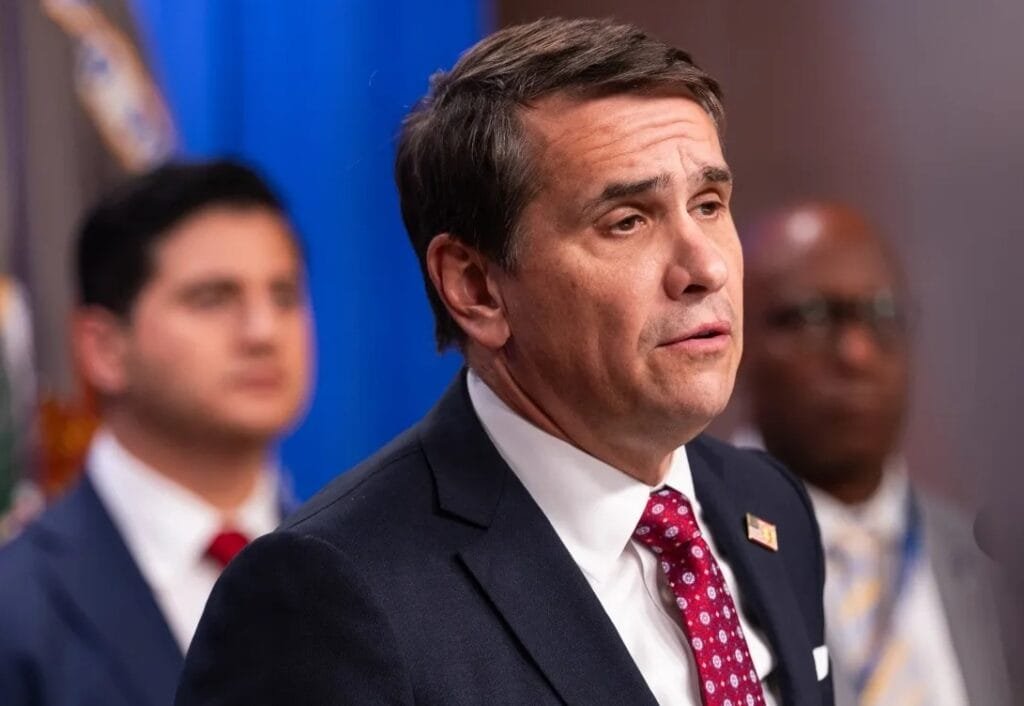
Todd Blanche
Justice Department officials removed several images from the public release of files tied to convicted sex offender Jeffrey Epstein in order to protect victims, Deputy Attorney General Todd Blanche said Sunday, rejecting claims that the move was politically motivated.
Speaking on NBC’s Meet the Press, Blanche confirmed that multiple photographs were taken down after the Department of Justice released a massive batch of Epstein-related documents on Friday.
“There were a number of photographs that were pulled down after being released,” Blanche said. “That’s because a judge in New York has ordered us to listen to any victim or victim rights group if they have any concerns about the material that we’re putting up.”
Attention has focused on one image that showed an open desk drawer containing several photographs, including one depicting future President Donald Trump. The image was no longer available on the DOJ’s website hours after the release, prompting accusations that it had been removed to shield the president.
Blanche pushed back strongly on that claim, saying the decision had nothing to do with Trump. “You can see in that photo there’s photographs of women,” he said. “We learned after releasing that photograph that there were concerns about those women and the fact that we had put that photo up. So we pulled that photo down. It has nothing to do with President Trump.”
Blanche, who previously served as Trump’s personal attorney, has become the Justice Department’s main public spokesperson regarding the Epstein files. The release was mandated by Congress after a rare bipartisan push overcame objections from Trump and some members of his administration.
In a letter to Congress on Friday, Blanche acknowledged that the DOJ failed to meet the December 19 deadline set by the Epstein Files Transparency Act. He cited the sheer volume of material and legal restrictions imposed by a federal judge in Manhattan aimed at preventing the identification of victims.
According to Blanche, more than 1,200 victims or relatives were identified during the review process. References to them were redacted, along with information protected by attorney-client privilege and deliberative-process exemptions.
Blanche said Sunday that he and Attorney General Pam Bondi spoke with victims’ rights groups as recently as Thursday. He added that removed images could be reposted after additional redactions are applied. “If we need to redact faces or other information, we will,” he said. “And then we’ll put it back up.”
The partial release and extensive redactions have drawn sharp criticism from some lawmakers. Democrats on the Senate Judiciary Committee accused the administration of violating the Epstein Files Transparency Act and selectively shielding President Trump.
Blanche dismissed those accusations, insisting political considerations played no role. “Bring it on,” he said. “We are doing everything we’re supposed to be doing to comply with this statute.”
Before joining the Justice Department, Blanche represented Trump during his 2024 criminal trial in New York City, where the former president was convicted on 34 felony counts of falsifying business records—a connection that continues to fuel skepticism from critics as scrutiny over the Epstein files intensifies.