Small Businesses Say Trump’s Tariffs Are Crushing Them: “We’re Just Working to Pay Off Tariff Debt”
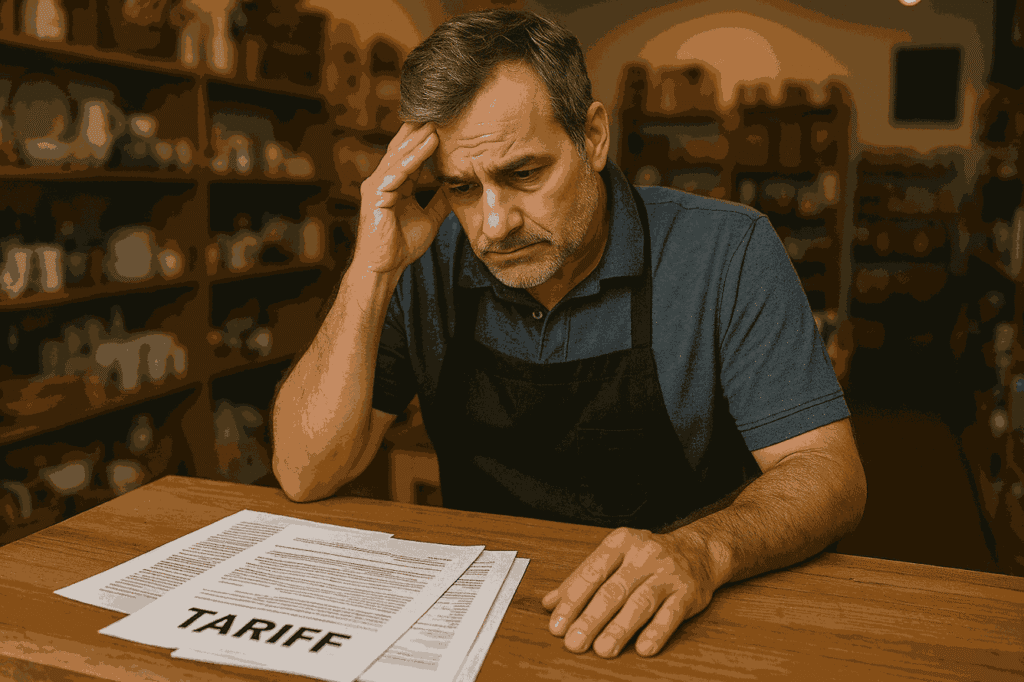
A small-business owner standing in their shop looking worried, with “tariff” paperwork spread out on the counter - image illustration The Newz Square
Donald Trump’s tariffs are pushing up prices on popular holiday products and forcing a “massive” number of small businesses to shut down, industry leaders warned this week.
On Small Business Saturday, many owners hoped holiday sales might soften what has been a brutal year. But few are optimistic.
Joann Cartiglia, who runs Queen’s Treasures — a toy company in Ticonderoga, New York — said she and her husband poured much of their retirement savings into their business, only to watch tariffs wipe out their future.
“My husband and I invested our retirement money into this business,” she said during a briefing organized by We Pay the Tariffs, a coalition of small firms.
“And now I have absolutely no hope of retirement.”
“I honestly feel the government is putting me out of business,” added Cartiglia, 64.
Lawsuits, opposition from big business, and pleas for help from small importers have failed to persuade the Trump administration to reconsider its aggressive strategy on trade from overseas, which the US president claims will raise trillions of dollars for the federal government.
Opponents of tariffs are “serving hostile foreign interests”, Trump has claimed.
Small businesses, particularly in the retail industry, typically rely heavily on the holiday trading season, but are grappling with increased costs, supply chain disruption, logistical issues and uncertainty due to tariffs.
Tariffs have hit some small businesses especially hard, as they often have smaller margins – and are less able to absorb costs, or secure exemptions – than bigger firms.
Jared Hendricks has run Village Lighting Co in West Valley City, Utah, which specializes in holiday lights and decorations, for over 20 years. He estimates his tariffs costs are approaching $1m so far this year.
“At this point, we’ve kind of transitioned from working for profits to working for tariffs,” said Hendricks. “We are just in business to pay off our tariff debt.”
But some operators anticipate that the problem is likely to get worse.
“Whatever price increases you’re seeing in the holiday industry for your Christmas trees, for your lighting, for your other decor, this year will be small compared to next year, if tariff relief isn’t given for the 2026 season,” added Hendricks. “American manufacturing has never done Christmas goods, so it’s not responsible for taking away any jobs.
“The supply chain for Christmas items is simply too complex, and [it] would take billions of dollars in decades to build that infrastructure to move that production here. And then, even if you did, the workforce is not sufficient to support it.”
Boyd Stephenson, owner of Game Kastle College Park in College Park, Maryland, said the firm’s costs had soared due to the tariffs. “Most of my manufacturers and publishers don’t really have the space to absorb, or to pass on price increases to their customers, so they’re getting squeezed,” he said. “The number of toy and game studios that I have seen go under this year is massive.
“Up until a month ago, I’d be saying: ‘Hey, most of the federal workforce isn’t employed either, so we’re hunkering down for a terrifying holiday season.’ But we’re still pretty scared, even with the shutdown being over.”
A survey of 1,048 small businesses conducted by Small Business for America’s Future found 71% of small business owners expect tariffs to have a negative impact on consumer spending this holiday season, and 44% expect a very negative impact.
About 44% of small businesses surveyed reported raising prices due to tariffs, and 74% reported being worried about their business surviving over the next 12 months.
“The administration has consistently maintained that the cost of tariffs will ultimately be paid by the foreign exporters who rely on access to the American economy, the world’s biggest and best consumer market,” said White House spokesperson Kush Desai. “As tariffs secure new trade deals and trillions in investments to make and hire in America, the Administration is simultaneously implementing a pro-growth agenda of tax cuts, deregulation, and energy abundance for big and small businesses alike to thrive again as they did during President Trump’s first term.”.